
Subwave Sensor Description:


Subwave Sensing has developed a digital diagnostic, Radio Frequency MicroElectroMechanical System (RF-MEMS) to very accurately and reliably measure multi-axial strain in a myriad of alloy and composite materials used to maintain structural integrity. The basis of our technology is the patent pending split ring resonator (SRR) sensor design that is passively powered (i.e. no internal power source), highly flexible and does not require a physical connection (i.e. wires) to receive or transmit load information. The Subwave Sensor is the next evolution in measuring strain in critical load bearing applications.
There are three primary components of the Subwave MEMS system:
There are three primary components of the Subwave MEMS system:
- Split Ring Resonator Sensor
- Nested Antenna
- Handheld Electromagnetic Radio Frequency Reader
Operating Principal
The Subwave Sensor is glued onto the component of interest (in the example below, a standard locking bone plate) using an epoxy resin that results in a protective layer over the intricate "fingers" of the nested split ring resonator sensor. The electromagnetic reader is held over the implanted or concealed sensor for a few seconds, which allows the radio frequencies to passively excite the sensor and report the resonance frequency of the current load back to the reader where it is stored until analysis.
The raw data is processed using a proprietary software algorithm, which can be customized in a wide variety of different customer output requirements. For our orthopaedic clients, the data analysis output is focused on the shift of the load from the bone plate to the bone itself over the healing period. For our aviation clients, the data analysis is more concerned with material fatigue and failure over time. For our civil engineering clients, the data is used to closely monitor crack size in bridges over time.
Although each data output is different, metal and alloy materials generally follow predictable patterns of fatigue, stress, strain and fracture that are well characterized, except for composite materials that have ill-defined failure points (i.e. Young's modulus) as a function of their unique composition; a matrix (e.g. resin) and a reinforcement material (e.g. carbon fiber). This is where the increased sensitivity and accuracy of the Subwave Sensor can elucidate these failure points better than the traditional strain gauges when used to evaluate new composite materials.
The raw data is processed using a proprietary software algorithm, which can be customized in a wide variety of different customer output requirements. For our orthopaedic clients, the data analysis output is focused on the shift of the load from the bone plate to the bone itself over the healing period. For our aviation clients, the data analysis is more concerned with material fatigue and failure over time. For our civil engineering clients, the data is used to closely monitor crack size in bridges over time.
Although each data output is different, metal and alloy materials generally follow predictable patterns of fatigue, stress, strain and fracture that are well characterized, except for composite materials that have ill-defined failure points (i.e. Young's modulus) as a function of their unique composition; a matrix (e.g. resin) and a reinforcement material (e.g. carbon fiber). This is where the increased sensitivity and accuracy of the Subwave Sensor can elucidate these failure points better than the traditional strain gauges when used to evaluate new composite materials.
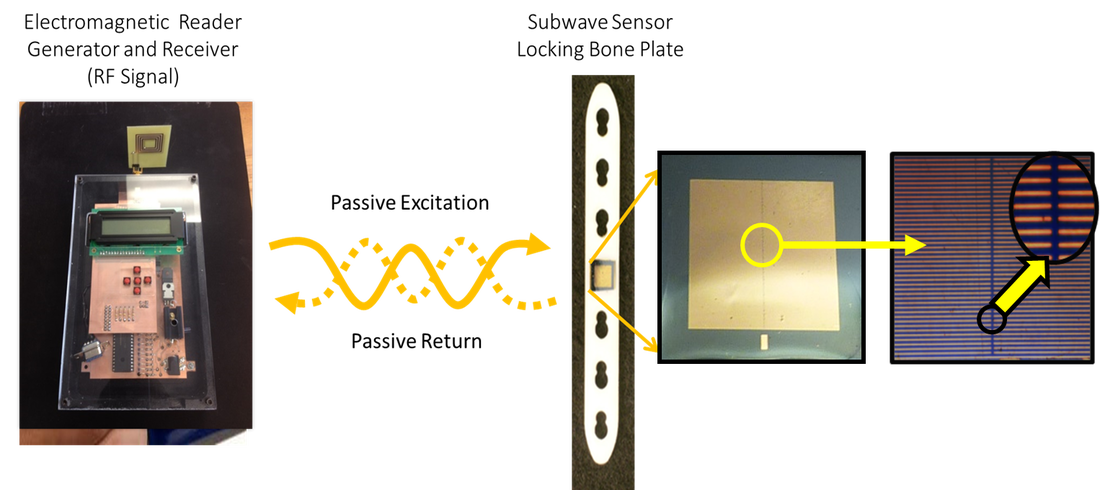
Please find more detailed information on our MEMS system in the three scientific publications below:
- Nested Metamaterials for Wireless Strain Sensing. R. Melik, E. Unal, N Kosku Perkgoz et. al., IEEE J. of Selected Topics in Quantum Electronics. Vol 16., No. 2., March/April 2010.
- Wireless Measurement of Elastic and Plastic Deformation by a Metamaterial-Based Sensor. B. Ozbey, H. Volkan Demir, O. Kurc et. al., Sensors. 14, 19609-19621, 2014.
- Implantable Microelectromechanical Sensors for Diagnostic Monitoring and Post-Surgical Prediction of Bone Fracture Healing. K.C. McGilvray,E. Unal., K.L. Troyer, et. al., J Orthop Res. Oct;33(10):1439-46, 2015.

|
|
|
||||||