
BIOMEDICAL - ORTHOPAEDICS


Subwave Sensing is poised to be the future of fracture care by giving the traditional orthopaedic hardware market an infusion of intelligence. Our Radio Frequency MicroElectroMechanical (RF-MEM) digital diagnostic sensor technology will facilitate post-surgical diagnostics for three of the most prevalent orthopaedic fracture conditions in contemporary medicine; namely, difficult diaphyseal and metaphyseal long bone fractures and complex spinal fusion cases.
Our Sensor would help achieve these goals by leveraging the use of our highly sensitive and flexible sensor on components that are highly angled, curved (> 180 degrees) or round. Furthermore, our sensor monitors Principal strain, which is a culmination of all of the forces on that critical component in multiple directions at the same time. This means that the component could be under compression and positive torsion at one testing point and tension and negative torsion the second testing point and our statistical algorithms can normalize these values and provide a total strain value, regardless of the forces applied to that component over time.
Leveraging this innovative diagnostic approach we can:
Our Sensor would help achieve these goals by leveraging the use of our highly sensitive and flexible sensor on components that are highly angled, curved (> 180 degrees) or round. Furthermore, our sensor monitors Principal strain, which is a culmination of all of the forces on that critical component in multiple directions at the same time. This means that the component could be under compression and positive torsion at one testing point and tension and negative torsion the second testing point and our statistical algorithms can normalize these values and provide a total strain value, regardless of the forces applied to that component over time.
Leveraging this innovative diagnostic approach we can:
- Improve patient outcomes by maximizing patient healing potential and minimize time to recovery
- Lower treatment costs by identifying problems very early in the healing process and in real-time so that the patient and healthcare provider can make more informed decisions as to the best treatment regimen
- Influence the way orthopaedic procedures are treated to ensure the highest possible success rate while at the same time eliminating poor performing implants and/or procedures
PROBLEM:
The US health care system is the most costly in the world, accounting for 17% of the gross domestic product with estimates that percentage will grow to nearly 20% by 2020 [1].
A primary contributor to the rising costs are hospital re-admissions, which exceed $17Bn Nationally. Of the $17Bn in readmission costs, it is estimated that ~10% ($1.7Bn) can be traced to fracture procedures [2]. These costs are not being reimbursed as quickly, if at all, under the new healthcare system and therefore are a significant drain on hospital resources as well as prolonging the patient healing process resulting in increased lost-workplace time and increases in rehabilitation treatment time and costs.
If new treatment solutions are not developed, these costs will continue to rise concomitantly with the aging population. It is expected that the number of fractures in the United States will increase by 50% from 6.2M fractures today to over 9.0M fractures by 2025[3],[4], all primarily driven by the growth of the aging population. In 10% of these cases, some form of hardware fixation is used to stabilize the joints to facilitate healing[3].
Subwave Sensing has a disruptive platform solution that leverages the use of post-operative, real-time data collection and analysis to provide quantitative assessments of bone healing very early on in the osteogenic healing process. This increased response time will allow the clinician to make adjustments to the treatment process to prevent the escalation of impaired bone healing cases thus greatly reducing costs, improving patient outcomes and fundamentally changing how fractures are treated in the future.
A primary contributor to the rising costs are hospital re-admissions, which exceed $17Bn Nationally. Of the $17Bn in readmission costs, it is estimated that ~10% ($1.7Bn) can be traced to fracture procedures [2]. These costs are not being reimbursed as quickly, if at all, under the new healthcare system and therefore are a significant drain on hospital resources as well as prolonging the patient healing process resulting in increased lost-workplace time and increases in rehabilitation treatment time and costs.
If new treatment solutions are not developed, these costs will continue to rise concomitantly with the aging population. It is expected that the number of fractures in the United States will increase by 50% from 6.2M fractures today to over 9.0M fractures by 2025[3],[4], all primarily driven by the growth of the aging population. In 10% of these cases, some form of hardware fixation is used to stabilize the joints to facilitate healing[3].
Subwave Sensing has a disruptive platform solution that leverages the use of post-operative, real-time data collection and analysis to provide quantitative assessments of bone healing very early on in the osteogenic healing process. This increased response time will allow the clinician to make adjustments to the treatment process to prevent the escalation of impaired bone healing cases thus greatly reducing costs, improving patient outcomes and fundamentally changing how fractures are treated in the future.
Biologic Model of the Osteogenic Remodeling Process
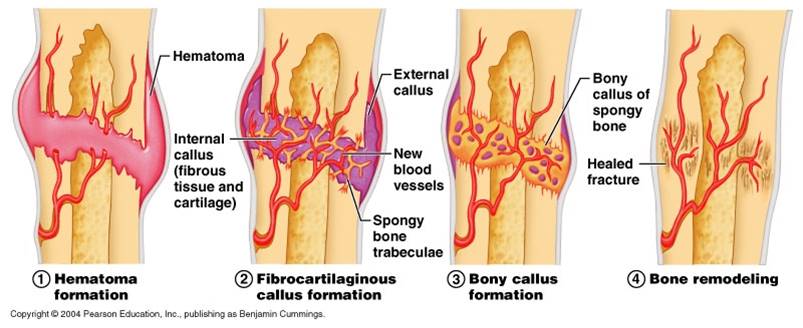
Biomechanics of the Osteogenic Remodeling Process
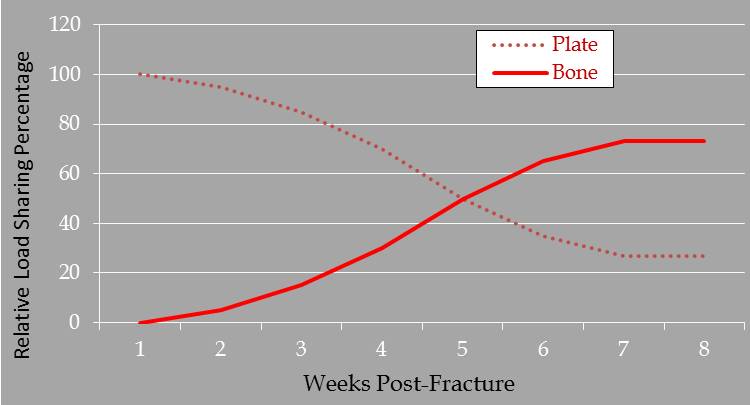
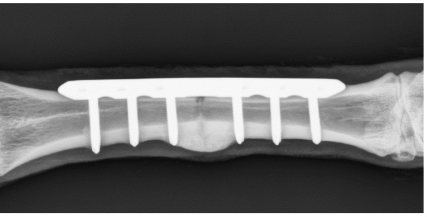
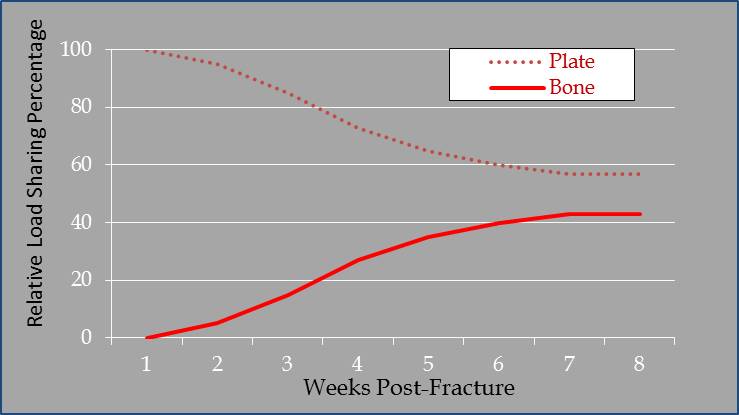
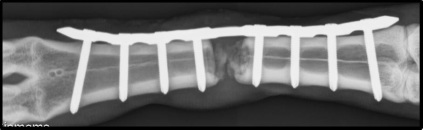
A typical healing period after a simple fracture can be as fast as five weeks in a healthy, active individual and as long as twelve months or more, in a complex fracture case with multiple patient co-morbitities (e.g. diabetic, obese, smoker etc.). The following illustrations taken from Subwave Sensing in-vivo models demonstrates the difference between normal and impaired healing cases and the predictive pattern that each model creates when measuring principal strain across the plate and fracture site.
|
NORMAL HEALING
|
IMPAIRED HEALING
|
[1] National Healthcare Expenditure Projections, 2010-2020 Centers for Medicare and Medicaid Services, Office of the Actuary.
[2] Weiss, A.J., et al., Healthcare Cost and Utilization Project. Statistical Brief #154. April 2013.
[3] Calori, G., Albisetti W., et al. 2007: Risk Factors Contributing to Fracture Non-Unions. Injury 38(Suppl 2): S11-18.
[4] La Neve, T., Boden S. et al. (4 Oct 2012): Bone Fractures, a $17B Market and Growing.
[2] Weiss, A.J., et al., Healthcare Cost and Utilization Project. Statistical Brief #154. April 2013.
[3] Calori, G., Albisetti W., et al. 2007: Risk Factors Contributing to Fracture Non-Unions. Injury 38(Suppl 2): S11-18.
[4] La Neve, T., Boden S. et al. (4 Oct 2012): Bone Fractures, a $17B Market and Growing.
NOTE: This product has not been approved by the Food and Drug Administration (FDA) or other regulatory body for use in the United States or any other country.